
Daniel Otero Meza's doctoral thesis becomes a book from Editorial Unisucre
Written with Juan José Cabello Eras and Jairo Guadalupe Salcedo Mendoza, the book puts in the hands of planners, waste management companies, lecturers and students the method for choosing how to recover energy from a city's waste.
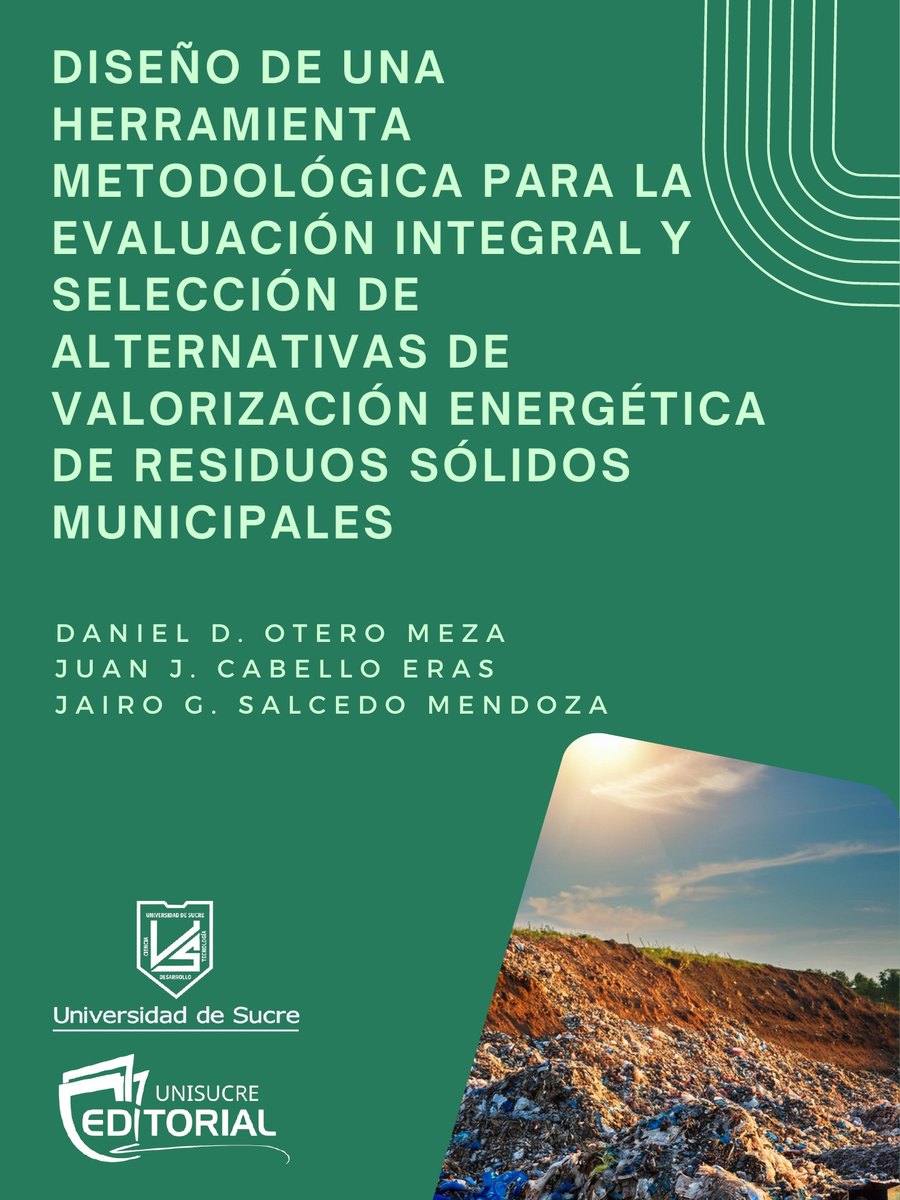
Three months after defending his doctoral thesis, Daniel Otero Meza saw it turned into a book. In March 2025 Editorial Unisucre published the first edition of the book on a methodological tool for the integrated assessment and selection of energy recovery alternatives for municipal solid waste, written with Juan José Cabello Eras, the thesis supervisor, and Jairo Guadalupe Salcedo Mendoza, its co-supervisor.
The book starts from a figure that demands action. The world produces some two billion tonnes of municipal solid waste every year, and that amount is expected to double by mid-century. Over five chapters it covers multi-criteria decision methods and their limits, the four energy recovery routes (incineration, anaerobic digestion, gasification and landfill with biogas capture), time-series models to project waste, and the design of the tool, which weights the criteria with an objective method and ranks the alternatives with TOPSIS.
The last chapter applies the tool to Sincelejo, where landfill with biogas capture came out as the most balanced option. The book's value, however, lies in the fact that the method can be repeated in other cities with waste disposal data, and that it explains every step so that people who did not take part in the research can use it.
It is a research book of 149 pages, ISBN 978-628-96839-0-5.